
Key points raised by PACJA on Pathways to Beneficiation and Regional Value Chains in Critical Minerals

New PACJA Strategic Plan (2026-2030) in Place: What Does It Include?
April 20, 2026
PACJA Monthly Update – April 2026
May 15, 2026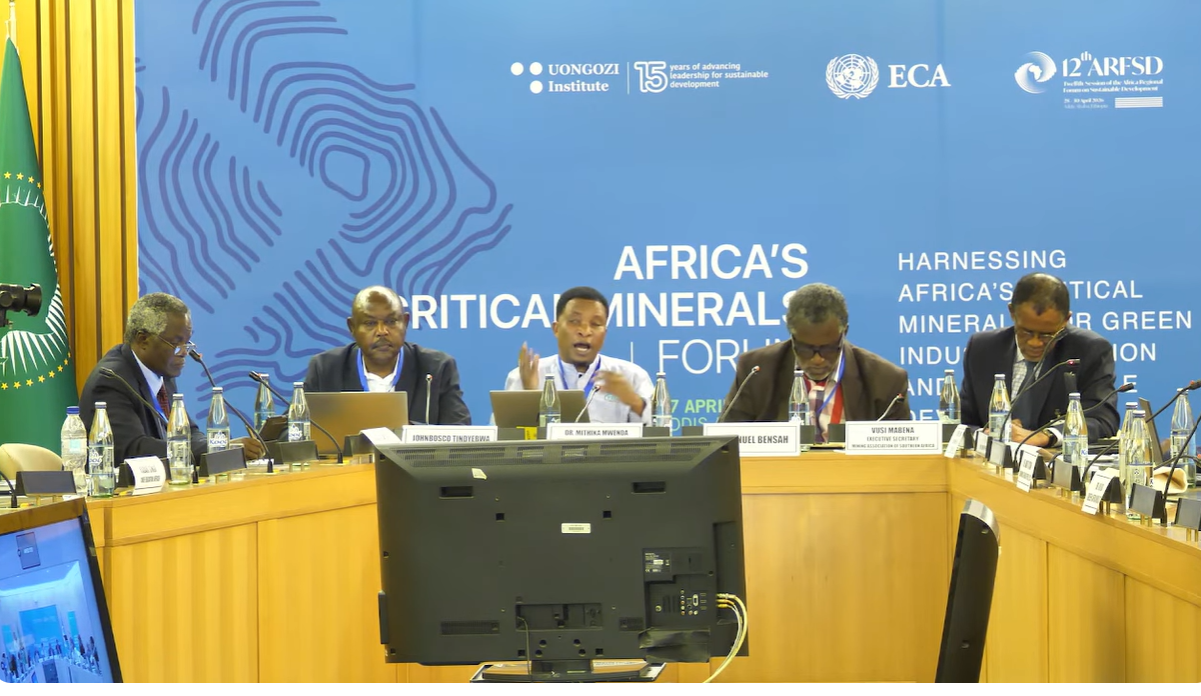
In line with the Africa Regional Forum on Sustainable Development (ARFSD12), today, on 27th April 2025, Addis Ababa, Ethiopia, PACJA participated in the Africa’s Critical Minerals Forum convened by UONGOZI Institute, in collaboration with the United Nations Economic Commission for Africa (UNECA). The Forum discussions focused on the theme: “Harnessing Africa’s critical minerals for green industrialisation and sustainable development”.
Under this high-level engagement, PACJA, through its Executive Director, Dr Mithika Mwenda, stressed the Pathways to Beneficiation and Regional Value Chains in Critical Minerals. The following are the key points raised by Dr Mithika Mwenda, Executive Director of PACJA:
Africa’s natural resources and contextual narrative
For decades, discussions surrounding Africa’s rich resource endowment have been prevalent, often beginning with the assertion that “Africa is rich in resources”. However, the uncomfortable reality is that despite this abundance, the continent struggles to capture value, remaining largely confined to the initial extraction stage of the global value chain. To effectively transition toward a greener and more sustainable economy, Africa must rethink its strategies and focus on reclaiming its place within higher value-added processes.
The global value chain consists of four key steps: extraction, processing, manufacturing, and the trade of high-value chain products. Currently, Africa finds itself primarily struck at the extraction phase. Leading to a replication of traditional extractive economies, albeit with cleaner operations. The pressing question has shifted from how to supply minerals to how Africa can sustain its presence in the value chain long enough to reap significant benefits.
Making Critical minerals beneficiation realistic
Beneficiation should not be viewed merely as a technical fix but rather as an industrial strategy that encompasses power supply, infrastructure, skills development, trade policy and market access. Effective processing of minerals relies heavily on energy availability and efficient logistics, making this not just a mining issue but a broader development model challenge.
Way forward for Africa and an effective approach
A critical aspect of moving forward involved recognising that no single African Nation can industrialise solely through mineral wealth. Instead, a regional approach is vital. Collaborative strategies are necessary, given that different countries possess unique advantages; some may be abundant minerals, while others have energy resources, ports or established industries. Strengthening regional value chains, supported by frameworks like the African Continental Free Trade Area (AfCFTA and the Regional Economic Communities, can foster industrial development across borders.
There are promising examples of regional collaboration. For instance, the Democratic Republic of Congo (DRC) and Zambia are pioneering a joint battery value chain to shift from exporting raw materials to producing battery components. Furthermore, the Lobito Corridor aims to connect Angola, DRC, and Zambia to Global markets. However, the focus needs to be on establishing development corridors that facilitate manufacturing rather than merely expediting mineral exports. Similarly, Morocco’s success in Battery manufacturing demonstrates the importance of integrating industrial policy with market access and infrastructure development.
Governance, policy and how it should work
Countries such as Zimbabwe have taken bold steps to enforce bans on raw Lithium exports, but without accompanying measures such as energy access and processing capabilities, such policies could fall short. There is a pressing need to align mineral extraction with energy, industrial and trade policies to ensure comprehensive integration.
Shifting away from disjointed policies for the restructuring.
While Africa faces significant challenges, including unreliable energy, fragmented policies, and limited financial resources, the restructuring of global supply chains presents new opportunities. As demand shifts towards secure and diversified resources, the continent can leverage its resources effectively, but only through collective action.
National competition avoidance for Regional Coordination
Moving away from National competition towards regional coordination, focusing on midstream value creation and ensuring local participation are imperative for Africa to not only extract minerals but also to capture meaningful economic benefits.